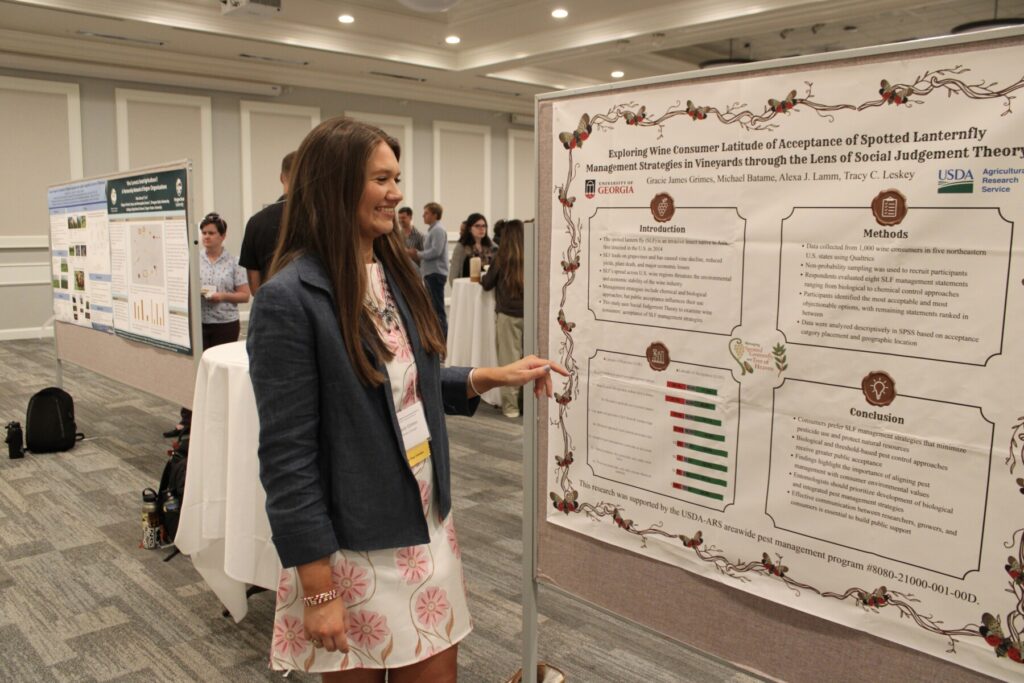
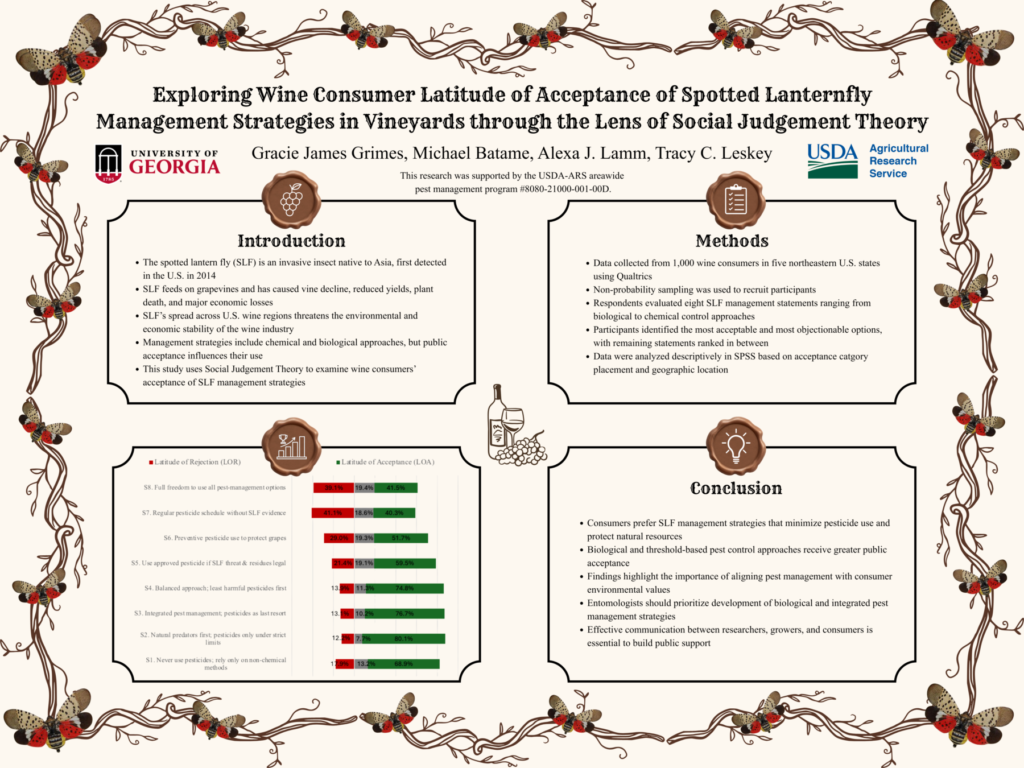
At the 2026 International Association for Society and Natural Resources (IASNR) conference, Gracie Grimes presented a poster titled Exploring Wine Consumer Latitude of Acceptance of Spotted Lanternfly Management Strategies in Vineyards through the Lens of Social Judgement Theory during the poster session on Monday night.
This study explored how wine consumers perceive various management strategies for controlling the Spotted Lanternfly (SLF), an invasive pest increasingly threatening vineyards across the U.S. As growers employ both biological and chemical methods, understanding public acceptance of these approaches is important. Using Social Judgement Theory, 1,000 wine consumers from five northeastern states were surveyed. These consumers indicated which SLF control methods they found most acceptable and most objectionable, enabling insights into consumer attitudes toward different pest management options.
The results indicated a strong preference for environmentally sustainable management strategies. Methods like biological control, natural predators, and integrated pest management were most accepted by respondents. As a result, routine and preventative pesticide applications were the least favored options. These findings highlight that consumers highly prioritize sustainability and lowering chemical use when assessing agricultural pest control methods.
This research emphasizes the need to consider public perceptions with scientific effectiveness in pest management strategies. Understanding consumer attitudes helps researchers, growers, and communicators develop solutions that are effective, publicly supported, and profitable for consumers. The work was conducted as part of the USDA ARS Areawide project focused on developing biological controls for SLF and Tree of Heaven.