Lamm Lab members shared research on animal production, meat science, consumer decision-making, and science communication at the Association for Communication Excellence (ACE) Conference, held June 15 – 17, 2026, in Billings, Montana. Through one research poster and two oral presentations, the team explored how communication strategies, social media engagement, music, and personal values influence public perceptions and decision-making related to food production and agricultural innovations.
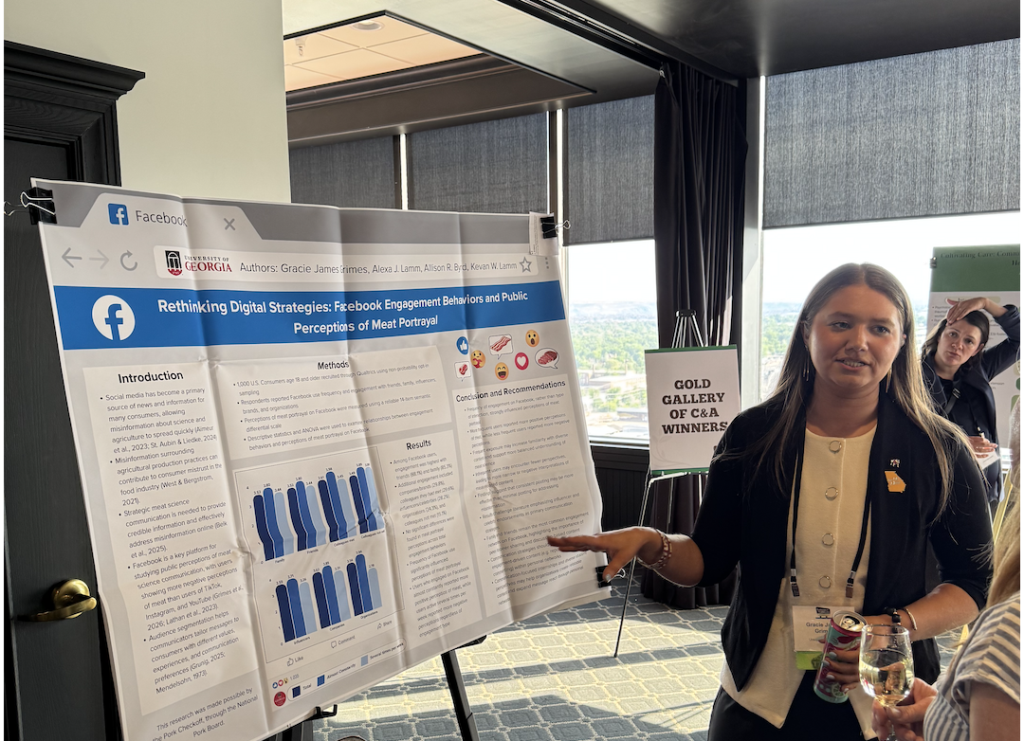
Gracie Grimes presented a poster Gracie James Grimes presented a poster titled “Rethinking Digital Strategies: Facebook Engagement Behaviors and Public Perceptions of Meat Portrayal.” The study explored how Facebook engagement behaviors influence consumers’ perceptions of meat-related content online. Using survey data from 1,000 adults in the United States, the researchers examined participants’ frequency of Facebook use, engagement with different network groups (e.g., friends, family, influencers, brands, and organizations), and perceptions of how meat is portrayed on the platform. The results indicated that the frequency of Facebook engagement, rather than the type of network or interaction, significantly influenced perceptions of meat. Individuals who engaged with Facebook more frequently reported more positive perceptions of meat-related content, while less frequent users reported more negative perceptions. The findings suggest that science communicators and agricultural organizations may benefit from prioritizing consistent, engagement-driven communication strategies and leveraging peer-to-peer networks to foster more positive and informed perceptions of meat production and agriculture.

Dennis Baffour-Awuah delivered an oral presentation titled Beats, Beliefs, and Bioengineering: Exploring How Music Shapes Attitudes toward Gene-Edited Pigs on Instagram. The study examined how music recognition, music-message congruency, and music engagement influence attitudes toward gene-edited pigs when scientific information is communicated through an Instagram-style reel with background music. The researchers tested three genres of background music: rap, pop, and country. The findings indicated that music recognition alone did not influence attitudes toward gene-edited pigs. Instead, music-message congruency and music engagement were significant predictors of more positive attitudes. In particular, music that felt appropriate for the message and increased audience engagement was associated with more favorable perceptions of gene-edited pigs. These findings indicate that science communicators using social media reels should go beyond just choosing popular or trending songs as background music. Instead, they should select audio that complements and enhances the scientific message being shared. The research highlights the importance of considering audience experience and emotional engagement when designing science communication content for social media platforms.

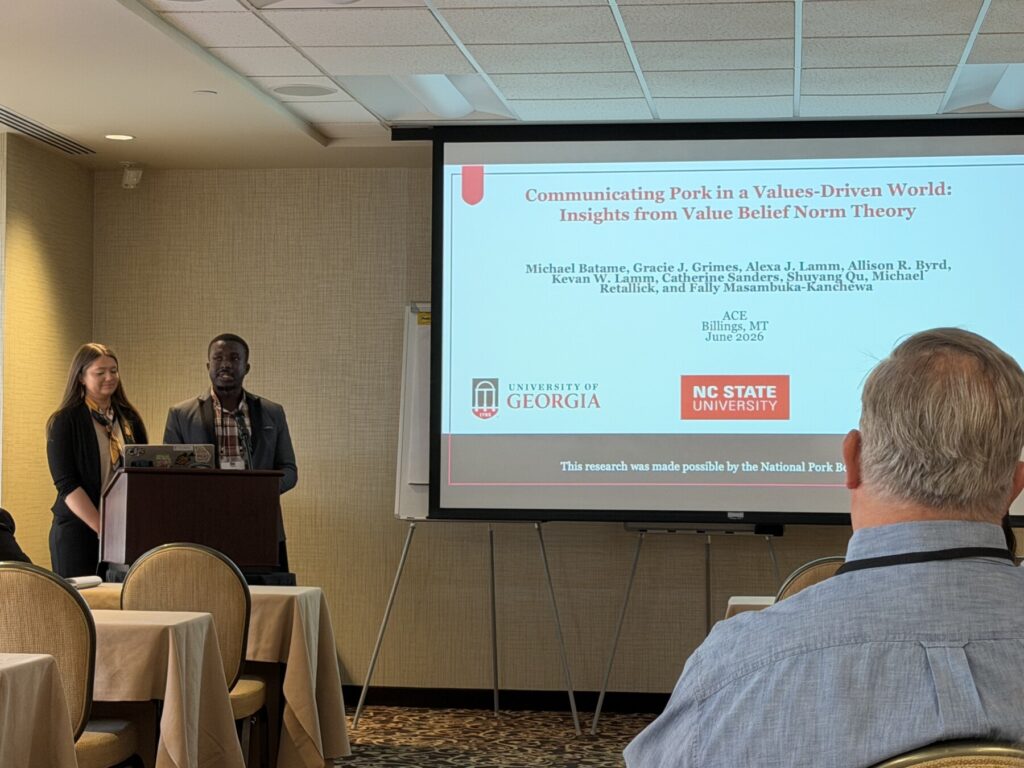
Michael Batame and Gracie Grimes gave an oral presentation titled Communicating Pork in a Values-Driven World: Insights from Value Belief Norm Theory. The study applied the Value Belief Norm Theory (VBN) to explore the psycho-social and value-based determinants of consumers’ pork consumption decision-making. Two objectives and 11 hypotheses guided the study, and the structural equation modeling was conducted in RStudio. The findings indicated that hedonic and biospheric values predicted awareness of consequences; awareness of consequences predicted ascription of responsibility; ascription of responsibility predicted personal norms; and personal norms predicted behavioral intentions towards pork consumption decision-making. Additionally, biospheric values had a positive indirect effect on behavioral intentions, whereas hedonic values had a negative indirect effect. This suggests that traditional pork marketing, focusing on price and taste, is no longer sufficient. Therefore, marketing strategies should emphasize sustainability, environmental stewardship and animal welfare practices.
Together, these presentations highlighted the important role of communication in shaping public understanding of animal agriculture, food production, and emerging agricultural technologies.
