Upcycled food is emerging as a novel food category connected to efforts to reduce food waste and support more sustainable food systems. According to the Upcycled Food Association, it is the easy way for anyone to prevent food waste via the products they buy, and they do so by creating new, high-quality products out of surplus food. It is also an innovative approach to food waste, as it is the first consumer-product-based solution, making it highly scalable and economically sustainable.
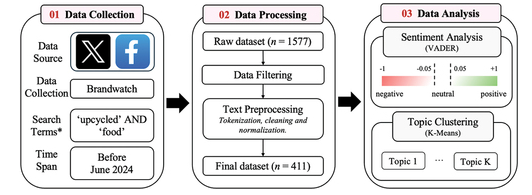
A recent study by Lulu Mao, Peng Lu, Min Zhuang, Shiyan Jiang, and Alexa Lamm explored how upcycled food is represented on social media. Published in Communication Research and Practice, the research employed Social Representation Theory to analyze public discussions about upcycled food on X and Facebook. The team applied text-mining techniques to social media posts to detect sentiment and prevalent themes in online conversations. They started with 1,577 social media records gathered through Brandwatch. After filtering out duplicates and irrelevant content, 411 relevant posts remained for further analysis. The researchers categorized the posts’ sentiments using VADER, classifying them as positive, negative, or neutral. Additionally, K-Means clustering helped identify the main themes present in the dataset.
What the Researchers Found
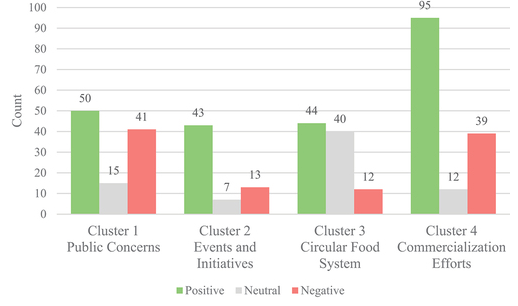
The sentiment analysis revealed that over half of the posts were positive. Specifically, 56.4% expressed positivity, 25.5% were negative, and 18.0% were neutral. While positive posts frequently emphasized upcycling’s role in protecting the environment and reducing food waste, negative posts conveyed feelings like anger, disgust, and concern. Neutral posts mainly provided information without clear opinions.
The cluster analysis identified four major themes in the social media discussion. The first theme focused on public concerns about upcycling byproducts into food. This cluster had the highest proportion of negative sentiment and included skepticism, misconceptions, safety concerns, anxieties about hidden health risks, and mistrust in food industry practices. The second theme focused on events and initiatives advancing upcycling to address food waste. This cluster was more action-oriented and included participatory, scientific, and entrepreneurial initiatives. The third theme connected upcycled food to circular food systems and environmental sustainability, often through research updates and institutional communications. The fourth theme focused on commercialization efforts, including product promotion, research and innovation, public education, market insights, and entrepreneurial examples.
The study revealed two contrasting discourses about upcycled food on social media. One centered on sustainability, promoted by organizations, and the other was characterized by consumer skepticism. The clustering separation reflects the sentiment distribution: negative sentiments mainly come from consumers, while positive sentiments are primarily generated by industry sources.
Implications for Communication
The authors noted that positive sentiment was primarily found in posts discussing events, initiatives, and commercialization, suggesting that institutional, organizational, and promotional voices largely influenced the favorable discussion. On the other hand, negative posts reflected public resistance to using byproducts in food production, especially where misconceptions and mistrust affected reactions to upcycled food.
The study recommends that communication and marketing strategies for upcycled food should focus on addressing consumer concerns about safety and quality. The authors also caution that excessive promotion without reassurance might increase skepticism. They suggest public education campaigns to correct misconceptions, explain risks and benefits, and help scientific understanding and public trust in upcycled food.
