A recent study exploring how tree-fruit growers in the eastern U.S. perceived the benefits and challenges of adopting Integrated Pest Management (IPM) through the lens of Diffusion Theory was recently published in Discover Sustainability. The full article, titled “Factors Influencing Tree-Fruit Growers’ Perceptions of IPM Implementation in the Eastern United States,” can be found here.

The authorship team included Dr. Chin-Ling Lee, Dennis Baffour-Awuah, Alexa Lamm, Monique Rivera, Christelle Guédot, Brett R. Blaauw, Allison Byrd, Gigi DiGiacomo, Jaime Piñero, Julianna Wilson, and Tracy Leskey. They are all working on a collaborative project to improve IPM strategies for eastern tree-fruit growers in the U.S., funded by the USDA Specialty Crop Research Initiative (#2024-51181-43213).
Why Understanding Growers’ Perspectives Matters
Integrated Pest Management (IPM) has evolved to enable growers who are heavily reliant on pesticides to adopt more ecologically sustainable approaches that reduce environmental pollution, ecological imbalance, and human health risks. Studies indicate that IPM can efficiently decrease pesticide use while maintaining yield. However, adoption of IPM remains limited, and advancements often prove short-lived. Additionally, the rate of adoption varies by region and crop type. For example, growers in tree fruit systems frequently face greater challenges due to the perennial nature of these systems and their susceptibility to cumulative pest damage, leading to high pest pressure, stringent market quality demands, elevated labor costs, production variability, and the need for year-round crop management.
Research Purpose and Approach
The study aimed to understand how tree-fruit growers perceive IPM, given its importance in promoting sustainable practices in perennial agricultural systems. This understanding can help prioritize regional IPM efforts and guide extension investments.
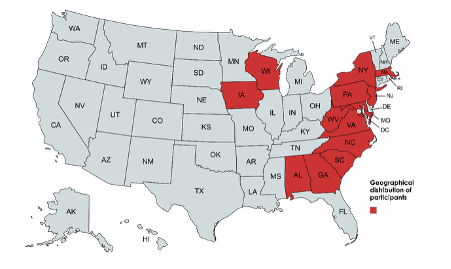
To do this, the researchers held seven focus groups with 82 tree-fruit growers across 12 eastern U.S. states to explore what influences growers’ adoption decisions. They applied Diffusion of Innovations (DOI) theory, which explains how perceptions of an innovation’s relative advantage, compatibility, complexity, trialability, and observability influence adoption. This approach helped the researchers understand how growers assess IPM practices within their specific operational contexts.
Key Findings
Growers generally viewed IPM positively, describing it as an effective and adaptable pest management approach. They highlighted strategies such as mating disruption, targeted spraying, monitoring systems, and rotating modes of action to reduce pest resistance and enhance long-term control. They also pointed out the ecological advantages of IPM, characterizing it as an environmentally friendly method that cuts toxic residues and minimizes damage to orchard ecosystems. Many explained that these benefits positively impact consumer perceptions and support marketing their operations as more sustainable.
It was also revealed that the growers faced significant challenges, including economic concerns such as rising labor costs, expensive inputs, and declining market returns, which made it difficult to adopt or sustain certain IPM practices. They described increasing difficulties related to changing weather patterns and invasive species, which create uncertainty and compel them to continually adjust their management strategies.
Examining Growers’ Experiences Through DOI Theory
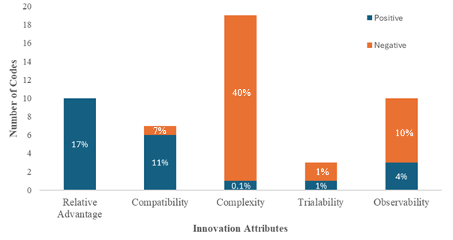
After coding the data segments to address perceived advantages and challenges, the researchers examined the growers’ lived experiences through the five Diffusion of Innovations (DOI) attributes. They found that growers generally perceived IPM as having significant relative advantage and compatibility with their operations, believing it beneficial and aligned with their farming goals. However, perceptions of complexity emerged as the main barrier to sustained adoption, with growers viewing IPM as knowledge-intensive and technically demanding, requiring specialized expertise, precise timing, and context-specific decision-making.
Additionally, growers felt that the benefits of IPM were not always visible or fully recognized by consumers or communities. Some also believed that limited opportunities to test new IPM approaches hindered their willingness to adopt these practices.
The figure below illustrates how growers’ positive and negative perceptions aligned with the five DOI innovation attributes, highlighting complexity as the strongest challenge associated with IPM implementation.
What Does This Mean?
The findings indicate that successful IPM adoption depends not only on scientific advice and technological improvements but also on effective communication, grower confidence, and their ability to manage complex agricultural systems. The researchers highlight that promoting IPM adoption involves more than just providing technical information. Growers benefit from peer learning opportunities, demonstration projects, hands-on experiments, and communication systems that help reduce uncertainty and help decision-making amidst changing environmental and economic conditions.
