In recent years, global poultry production has increased substantially in response to growing demand for affordable animal-source protein. To meet this demand, poultry production systems have become increasingly large and concentrated, creating significant challenges in disease management, productivity, and animal welfare. In such systems, manual flock monitoring and management are becoming increasingly impractical, highlighting the need for automated, data-driven approaches.
The Internet of Things (IoT) has emerged as a promising technological solution for continuous flock monitoring, data collection and sharing, and real-time decision-making. However, adoption of IoT technologies in poultry production remains relatively limited compared with their widespread application in crop production, transportation, and manufacturing. Meanwhile, advanced analytical approaches, particularly artificial intelligence (AI), have demonstrated considerable potential for transforming data collected through IoT-enabled devices into actionable information for poultry management.
The integration of IoT and AI technologies could help address many of the challenges associated with modern, large-scale poultry production systems. Although most applications remain at the research or pilot scale, these technologies have substantial potential to improve flock monitoring, enhance production efficiency, support early detection of health problems, and promote animal welfare. This narrative review examines the current state of IoT- and AI-based technologies for poultry production, both independently and in combination. It also identifies key limitations and research gaps and discusses opportunities and priorities for future development and implementation.
IoT Architecture in Poultry Production
In IoT systems, data flows through multiple layers starting from the sensors. In this review, we focus on a four-layer model consisting of the perception layer, network layer, processing layer, and application layer, as shown in Figure 1 to highlight the growing role of edge and cloud computing in poultry production.
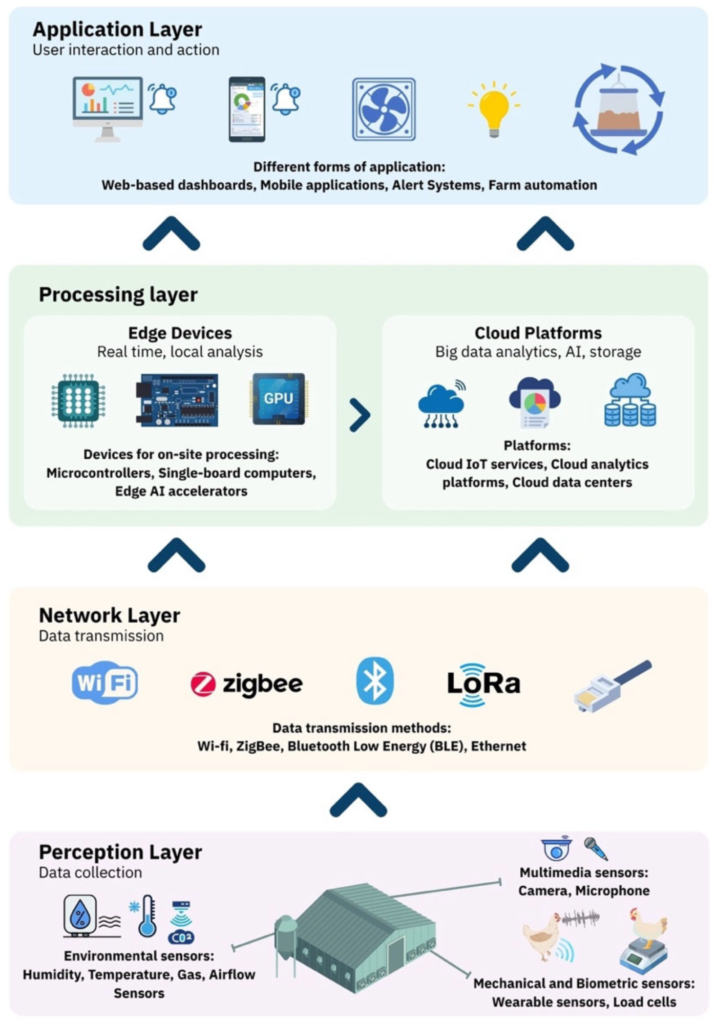
Fig. 1. Four-layer Internet of Things (IoT) architecture for poultry farms.
Modern poultry farms using IoT technology depend significantly on various types of sensors that track environmental conditions and the behavior of birds. These sensors vary in terms of cost, power consumption, precision, and scalability. Their performance is maximized when organized into a closed-loop system. IoT-backed systems in poultry farming have demonstrated notable gains in efficiency. For example, smart environmental control can optimize conditions like temperature and ventilation, improving feed conversion and reducing wasted resources. A robotic litter sanitation system showed how automation can cut energy use by optimizing movement paths – a back-and-forth navigation pattern minimized turning, thereby lowering power consumption during litter decontamination. Similarly, integrating AI with IoT (e.g. computer vision at the edge) can increase the FCR and reduce mortality, leading to more efficient production overall. Advanced predictive models using farm sensor data (temperature, humidity, etc.) have been used to avoid resource waste while boosting growth – in one case, machine learning-based modeling improved poultry growth and feed usage efficiency, promoting more sustainable farming practices. In short, IoT implementations help farmers do more with less by tightening control over inputs and environmental parameters. Interconnected systems like IoT and AI together can reshape poultry production by turning continuous sensing into timely, actionable decisions that improve efficiency, reduce labor, and support bird welfare. A layered architecture with edge intelligence enables real-time monitoring and closed-loop control, while emerging technologies such as edge computing, multimodal fusion and lightweight models promise broader impact across diverse farm conditions. Remaining barriers include farm-scale validation, durable and self-calibrating hardware, shared standards for interoperability, clear return of investment, and strong practices for data security and welfare. Progress will depend on coordinated trials with growers and integrators, modular systems that can evolve without full replacement, and tight coupling of sensing with actuation and robotics. With these elements in place, IoT-enabled, AI-driven systems can become dependable, affordable, and welfare-oriented tools for commercial poultry production.
Research gaps in IoT poultry farming systems
Most IoT deployments in poultry are validated in small pilots and either rely on a single sensing modality or treat multiple sensors as separate, non-integrated channels that drive different actuators. This architecture is fragile under real barn conditions, where lighting, dust, occlusion, and noise vary throughout the day, and it reduces confidence in closed-loop control. Future work should prioritize multimodal sensor fusion, so signals corroborate and complement one another. Time-synchronized video, audio, environmental readings, load-cell events, and, where feasible, lightweight wearables should be fused at the data, feature, or decision level with shared timestamps and calibration. For example, vision-only behavior detection degrades when birds or feeders occlude the camera view. Adding a second camera angle and auxiliary cues such as wearables or acoustic indica-tors can recover missed events and suppress false alarms. Fused pipelines provide cross-validation and maintain accuracy when any single channel underperforms.
Effective implementation also requires resource-efficient edge devices that generate useful insights and support real-time decisions without sending large volumes of raw data to the cloud. This reduces network load and improves data security. Recent advances in micro-electronics and low-power computing have made compact edge deployments practical, and several studies have already demonstrated edge inference in poultry settings. Complementary progress in lightweight models further strengthens feasibility, for example TinyML classifiers for vocalizations and compact detectors for health or behavior, both running at real-time speeds on constrained hardware. Power remains a bottleneck for wearables and distributed nodes. Therefore, pairing low-power devices with adaptive functionality, including sleep modes during rest periods and event-driven wakeups, is recommended.
Poultry houses are dusty, humid, and often high in ammonia, which are harsh on electronics. Long-term feasibility of general-purpose components should be evaluated under poultry-house conditions, and purpose-built, low-cost hardware should be explored for sustained use. A modular pipeline that supports over-the-air updates and self-calibration is essential so systems can evolve without full hardware replacement. This reduces maintenance burden and avoids costly downtime in commercial operations.
Adoption depends on economics and trust, regardless of how well technology performs in research conditions. Farm-scale studies should therefore quantify return on investment, including effects on feed conversion, labor, and losses avoided, and should explore technologies from other domains.
Further reading:
Dhungana, A., Paneru, B., Dahal, S., & Chai, L*. (2026). A Narrative Review on Internet of Things and Artificial Intelligence for Poultry Production. Animals, 16(9), 1285.