Precision livestock farming (PLF) is defined as the management of individual animals by continuous, automated, and real-time monitoring of health, welfare, production/reproduction, and environmental impact. It encompasses a wide range of engineering principles, techniques, applications, and tools for data acquisition, pre-processing, modeling, post-processing, and analysis. Non-invasive techniques such as using wearable sensors, accelerometers, and radio frequency identification systems (RFID) are common in poultry and computer vision is gaining popularity these days. The goal of PLF is to provide real-time, automatic, continuous monitoring of animal health and welfare, providing producers with early warning signs that have potential production implications.
Researchers at the University of Georgia summarized the research models for precision poultry farming by reviewing most advanced models that were developed and tested for precision poultry farming in recent years. We found that the YOLO (You Only Look Once) model is one of most popular open-source deep learning models used for poultry welfare monitoring and individual chicken tracking (Figure 1 and Figure 2).

Fig. 1. The evolution of YOLO models with changes in Architecture, Optimization, Efficiency, and a Unified framework across years.
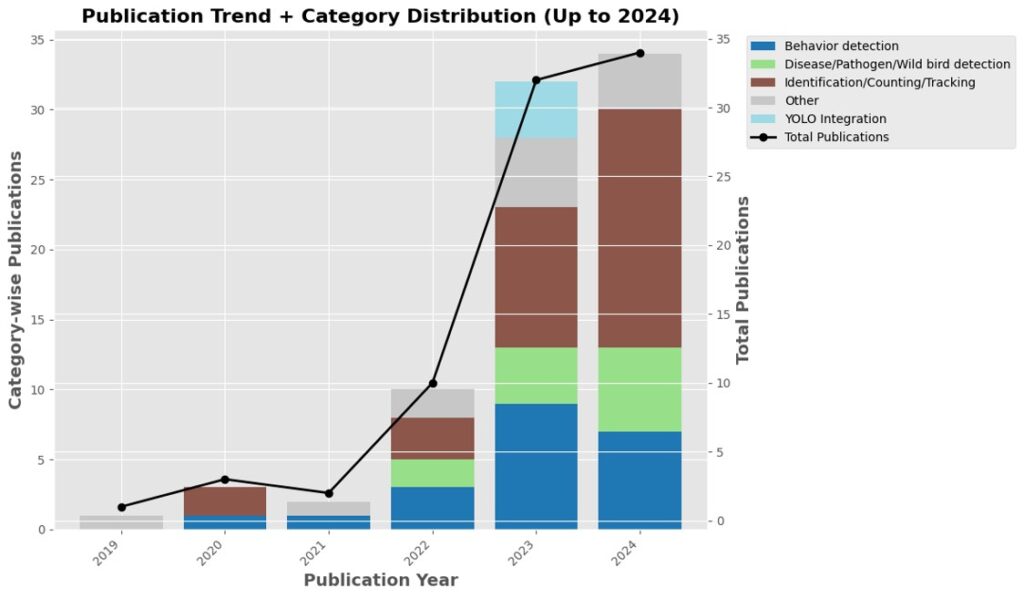
Fig. 2. Analysis of publication count of research articles using YOLO-based models in poultry by category by yearly distribution showing the trend line over the years (2015-2024)
YOLO models have evolved from YOLOv1 to YOLOv11 over the past decade, with architectural innovations in backbone design, detection heads, loss functions, and attention mechanisms progressively improving the balance between speed, accuracy, and robustness for real-time, non-invasive monitoring in precision poultry farming. This review synthesized 82 studies from 408 records (2015 to 2024), showing that modern YOLO-based systems, often integrated with tracking and other machine vision models, are now widely used for identification, counting, tracking, behavior detection, mortality surveillance, disease and pathogen detection, wild bird detection, flock distribution mapping, and activity index calculation in broilers and layers across diverse housing systems, with rapid publication growth since 2021 driven mainly by China and the USA. These applications are catalyzing a shift from manual observation to continuous, data-driven welfare and health management, with clear benefits for productivity, early disease detection, and animal welfare, yet practical challenges persist, including occlusion, variable farm infrastructure, limited dataset generalizability, and ethical considerations around monitoring. Fully realizing scalable, real-time, and humane YOLO-powered systems for commercial farms will require continued advances in dataset diversity and quality, edge-device compatibility, robust performance under commercial conditions, and explicit integration of animal welfare safeguards into system design and deployment.
Further reading:
Paneru, B., Dhungana, A., Dahal, S., Ritz, C. W., Kim, W., Liu, T., & Chai, L.* (2026). Computer vision models for precision poultry farming: A narrative review of behavioral and welfare monitoring studies. Poultry Science, 106887. https://doi.org/10.1016/j.psj.2026.106887