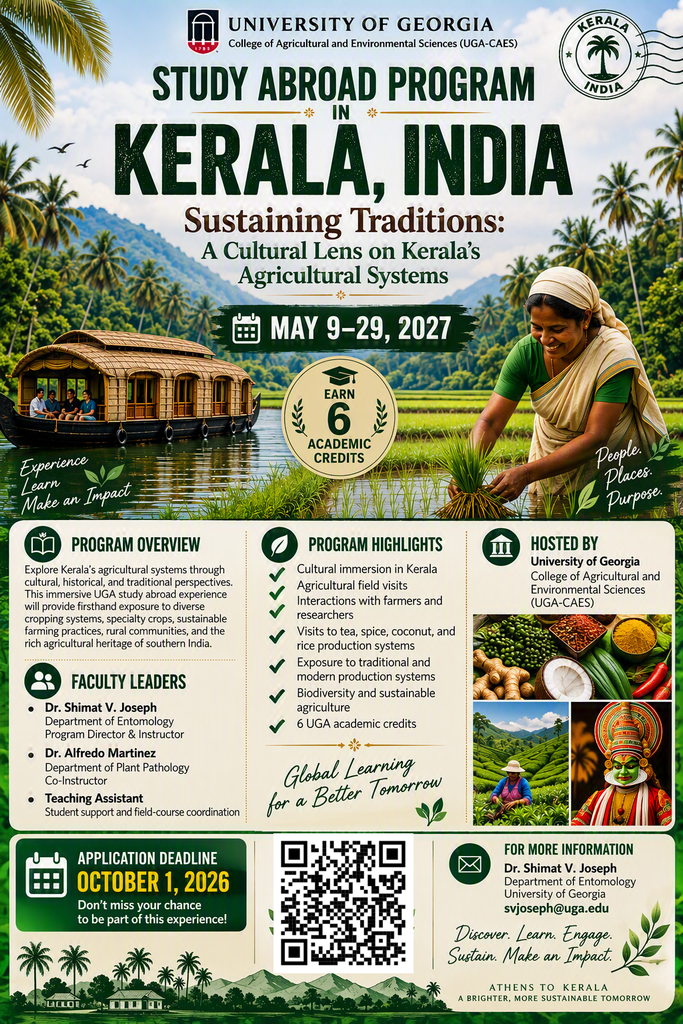
The University of Georgia’s College of Agricultural and Environmental Sciences (UGA–CAES) will offer a study abroad course titled “Sustaining Traditions: A Cultural Lens on Kerala’s Agricultural Systems,” scheduled to take place in Kerala, India, from May 9 to May 29, 2027. The instructor for this course will be Dr. Shimat V. Joseph. Dr. Alfredo Martinez (Department of Plant Pathology) will serve as co-instructor. A Teaching Assistant will be assigned to the course. The program will give students an immersive experience of Kerala’s agricultural practices through cultural and traditional perspectives. The course is designed for 12 students, primarily sophomores and juniors, and will be offered in odd-numbered years, alternating with another India-based study abroad program in even years. Acceptance will be based on interviews assessing students’ interests and career goals, with basic biology courses, such as PBIO 1220-1220L, BIO 1104-1104L, and BIOL 1108-1108L serving as prerequisites. Final costs will be determined later, but motivated students are encouraged to pursue scholarships through the college.
Kerala, located at the southern tip of India, is a tropical state renowned for its biodiversity, lush landscapes, and rich cultural heritage. Its geography, flanked by the Western Ghats and the Arabian Sea, supports a wide range of tropical crops and presents unique opportunities to study pest management and agricultural production. Students will engage with faculty and peers at Kerala Agricultural University, which operates multiple campuses and specialized research stations across diverse agro-climatic zones. They will also interact with agricultural officers from the Department of Agriculture, gaining firsthand insight into sustainable farming practices, pest control, and rural livelihoods. Beyond academics, students will experience Kerala’s vibrant traditions, classical arts, festivals, and cuisine, making this one of UGA’s most enriching study abroad opportunities.
This 6-credit course integrates two entomology components: Insect Pest Management (ENTO 3740, 3740L) and Special Problems in Entomology (ENTO 3900). Students will build foundational knowledge of insect anatomy, physiology, and taxonomy, supporting their understanding of integrated pest management strategies. Through case studies and fieldwork, they will explore how economic, social, and regulatory factors shape pest control decisions. Daily reflection sessions and active participation will form the basis of their assessment. Additionally, students will work one-on-one with faculty on independent entomological projects, culminating in a final presentation or creative output. Their learning will be evaluated through reflection meetings, particularly on Day 21, and through engagement in lectures, field tours, and discussions with local farmers and policymakers. This hands-on approach will deepen their understanding of pest management challenges and the broader agricultural landscape in Kerala.
Apply through the webpage https://studyaway.uga.edu/index.cfm?FuseAction=Programs.ViewProgramAngular&id=14160