The U.S. row crop sector is currently under significant economic pressure. Lower commodity prices, high input costs, policy uncertainty, and ongoing trade disruptions have combined to create a challenging operating environment for many producers. It is clear that all producers are currently facing a challenging farming environment. However, we also observe meaningful differences in outcomes and performance within this same difficult environment. Some farms remain relatively stable. Others experience severe financial stress. Some adjust quickly, while others struggle to respond.
Why? Traditional discussions of agricultural risk tend to focus on external shocks such as price volatility, drought, policy changes, or broader economic downturns. These factors certainly matter. They shape the environment in which farms operate. However, identical shocks do not produce identical outcomes. The difference is often not the shock itself, but how decisions are made in response to uncertainty.
Risk, by itself, does not generate outcomes; decisions do. Between an external shock and its eventual outcome lies a chain of decision processes. Producers must recognize emerging risks, interpret available information, evaluate alternatives, and choose a course of action. These decisions ultimately shape whether a farm remains resilient or experiences distress.
Consider a decline in commodity prices. Two farms may face the same market conditions. Yet one farm may recognize the threat earlier, have stronger financial reserves, or possess better market information. Another may have limited flexibility or delayed responses. The result is different outcomes despite facing the same shock.
This perspective suggests a shift in risk management away from simply identifying threats. Equally important is understanding how individuals and organizations process uncertainty and transform information into action. Rather than asking only, “What risks exist?” we should also ask, “How are decisions made in the face of risks as well as when the shocks emerge?”
The future of agricultural risk management will not be determined solely by better tools available to producers, such as better forecasting tools, insurance products, policy supports, or market information systems. It will also depend on improving the decision processes that connect uncertainty to outcomes.
In the next article, I will walk through what I call Liu’s 5Rs of Risk Management Model to explore how information systems, risk perception, behavioral factors, and structural constraints interact to shape real-world agricultural decisions and outcomes.
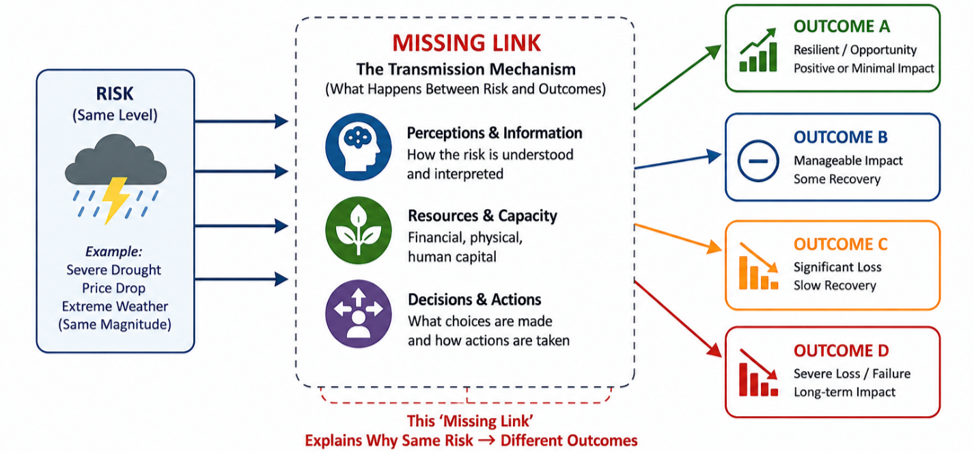
Figure 1. Same Risk, Different Outcomes: Where Is the Missing Link? (Designed with ChatGPT)
Alternative Text: Figure 1, Conceptual diagram illustrating why the same risk can lead to different outcomes. A box labeled “Risk (Same Level)” on the left points to a central box labeled “Missing Link: The Transmission Mechanism,” which contains three components: (1) Perceptions and Information—how risk is understood and interpreted; (2) Resources and Capacity—financial, physical, and human capital available to respond; and (3) Decisions and Actions—choices made in response to risk. From the transmission mechanism, arrows lead to four possible outcomes: resilient or positive outcomes; manageable impacts; significant losses; and severe losses or failure. The figure emphasizes that risk does not determine outcomes directly; instead, outcomes depend on how risk is perceived, the resources available, and the actions taken in response.