The One Big Beautiful Bill Act creates an opportunity to allocate up to 30 million additional base acres nationwide for covered commodities. Eligibility is based primarily on a farm’s planting history from 2019 through 2023. On June 1, 2026, the USDA Farm Service Agency (FSA) began sending Landowner Base Allocation Letters to producers and landowners. [Click here to access the letter.] The letters explain the new base allocation process and provide information about each farm’s potential eligibility for additional base acres beginning with the 2026 crop year.
What Does the Letter Tell You?
The Landowner Base Allocation Letter provides information about:
- The farm’s 2019 – 2023 historical acreage reported to FSA;
- Whether the farm is eligible to receive additional base acres; and
- The maximum number of additional base acres for which the farm may be eligible.
The nationwide allocation is capped at 30 million additional base acres. If total eligible acreage exceeds that limit, allocations will be reduced on a pro rata basis. Therefore, the acreage shown in the letter represents the farm’s potential eligibility and maximum allocation acres under the process; the final allocation acres for a farm may depend on the total number of eligible acres nationwide. It is important to note that unassigned base acres will be converted first, and any unassigned base acres converted to covered commodity base do not count toward the 30 million acre cap and are not subject to any proration.
Review Your 2019–2023 Acreage History
Because the allocation is based on historical acreage, the information reported to FSA for 2019 through 2023 may directly affect the farm’s eligibility and potential allocation.
Landowners should review the Base Allocation Summary for each farm and year, including: Planted acres; Prevented-planted acres; Failed acres; Double-cropped acres; Subsequent acres; and Acres planted to non-covered commodities. Compare the summary with your own farm records and look for missing or inaccurate information.
What Should Farmers Do?
If the Information Is Correct: No action is required. If the Base Allocation Summary accurately reflects the farm’s acreage history, eligible additional base acres will be allocated automatically. Farmers do not need to contact FSA to confirm that they agree with the information. The process preserves existing base acres for farms while allowing eligible farms to receive additional base acres.
If the Information Is Incorrect: Contact your local FSA county office to request a correction or appeal the information. The deadline for taking action is August 31, 2026.
If FSA is not notified by the deadline, the information on the Base Allocation Summary will be considered accurate and complete. The eligible acreage reported in the summary will then be used to determine the farm’s base allocation percentage and calculate additional base acres.
If Subsequent Acres Are Listed: If the Base Allocation Summary includes subsequent acres, producers and landowners should review them carefully and determine whether they should be selected for consideration in the base allocation calculation. If changes are needed, contact your local FSA county office before the August 31 deadline.
Why Do Additional Base Acres Matter?
Additional base acres can increase future federal farm program payments and should be viewed as a policy-based risk management tool. In the 5Rs of the Risk Management Model, this represents the Resources component, which focuses on leveraging available policy tools to strengthen a farm’s financial resilience.
Agriculture Risk Coverage (ARC) and Price Loss Coverage (PLC) payments are based in part on a farm’s base acres when market conditions and program rules trigger payments. Although base acres do not guarantee income, additional base acres may enhance the overall economic value of a farm by increasing potential future government payments under ARC and PLC programs.
Disclaimer: This article is for educational and informational purposes only. Producers should contact their local FSA county office for farm-specific questions and official determinations. For more information, please refer to the USDA FSA Agriculture Risk Coverage (ARC) & Price Loss Coverage (PLC) Webpage. [Click here to access the website.]
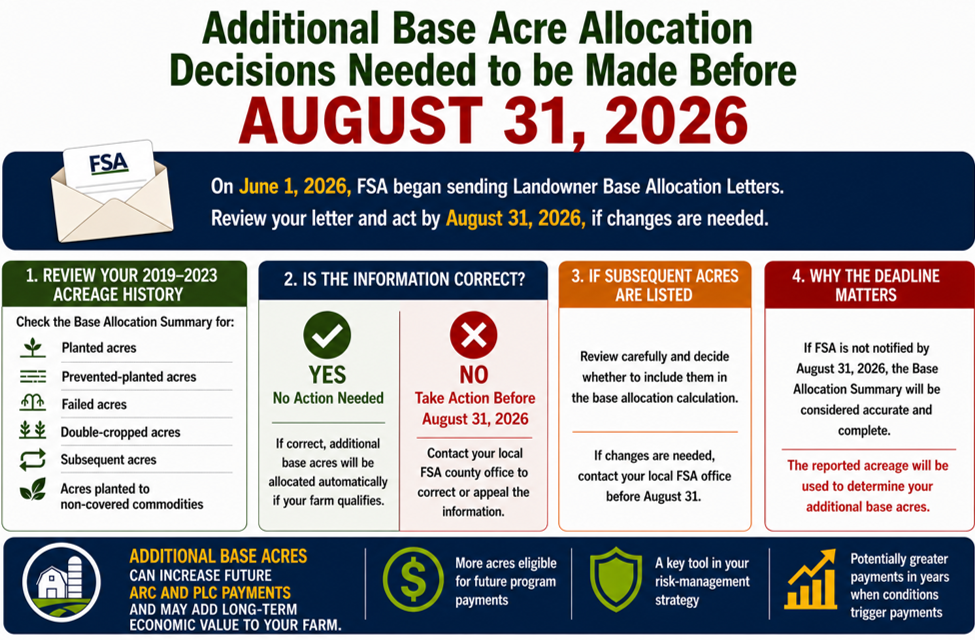
Figure 1. Key decisions associated with the additional base acre allocation under the One Big Beautiful Bill Act. Producers should verify their 2019–2023 acreage history and submit any corrections or appeals to their local FSA office by August 31, 2026. (Author designed with ChatGPT)
Alternative Text: Figure 1, Infographic summarizing USDA FSA Additional Base Acre Allocation decisions, highlighting the August 31, 2026 deadline, acreage records to review, actions to take if corrections are needed, and the importance of additional base acres for future ARC and PLC payments.