Not to be overly dramatic, but we have experienced pepper weevil captures on sticky traps at unprecedented numbers for this time of year. We have been running traps to monitor overwintering weevil numbers since 2018. The typical cycle (see 2022-23 data example below) is very high numbers (sometimes with individual traps with thousands per trap) in December and January whenever there is warm weather. Numbers typically drop during February (but can occasionally hit a small peak) but by March drop to very low numbers (rarely in double digits).
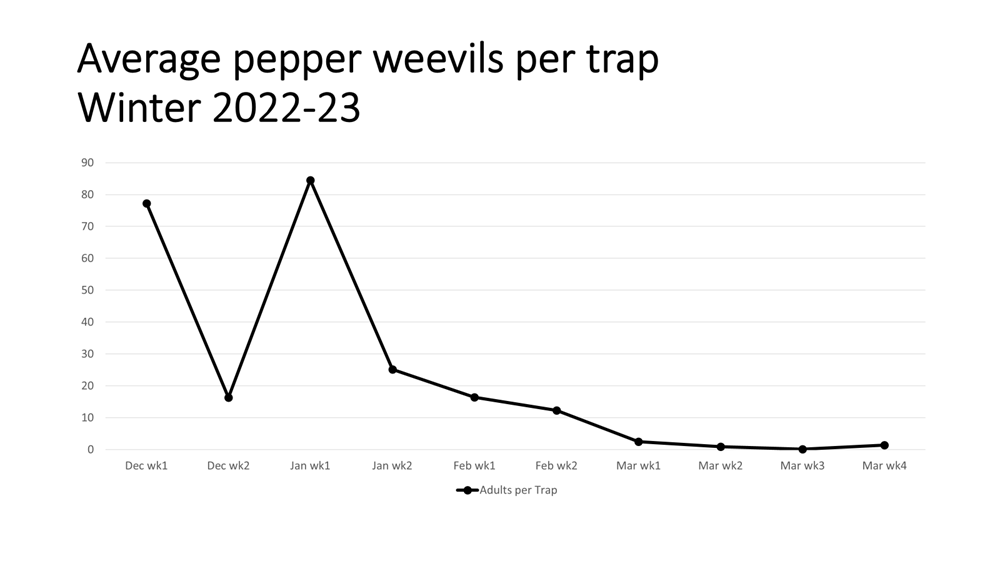
Pepper weevils are not known to diapause and are active whenever temperatures are warm. Thus, the assumption has always been that the large numbers going into overwintering are coming out of old pepper fields. Our winter temperatures are not cold enough to kill the weevils but do kill the weevil’s hosts (primarily pepper and eggplant). Times of activity during the winter, without adequate host material, results in high winter mortality and very few weevils surviving the Spring planting season.
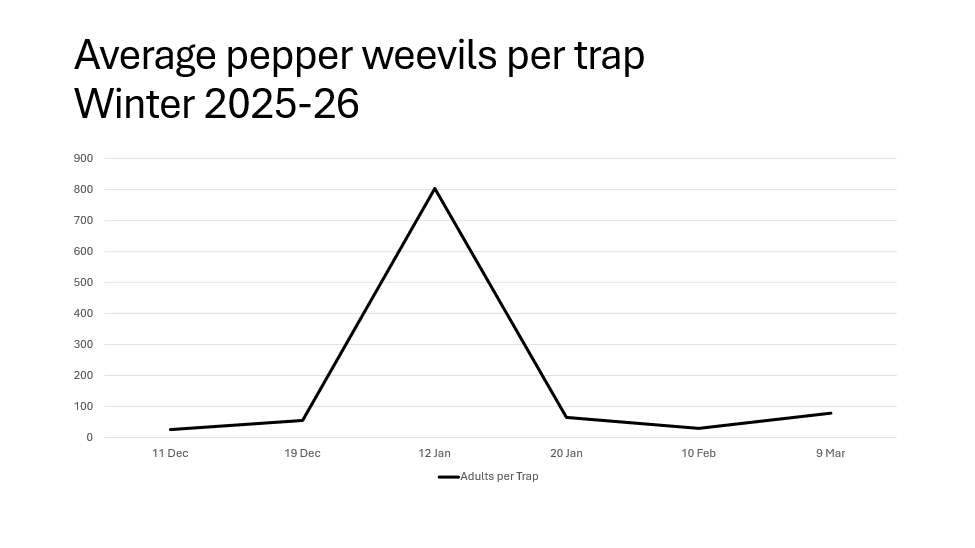
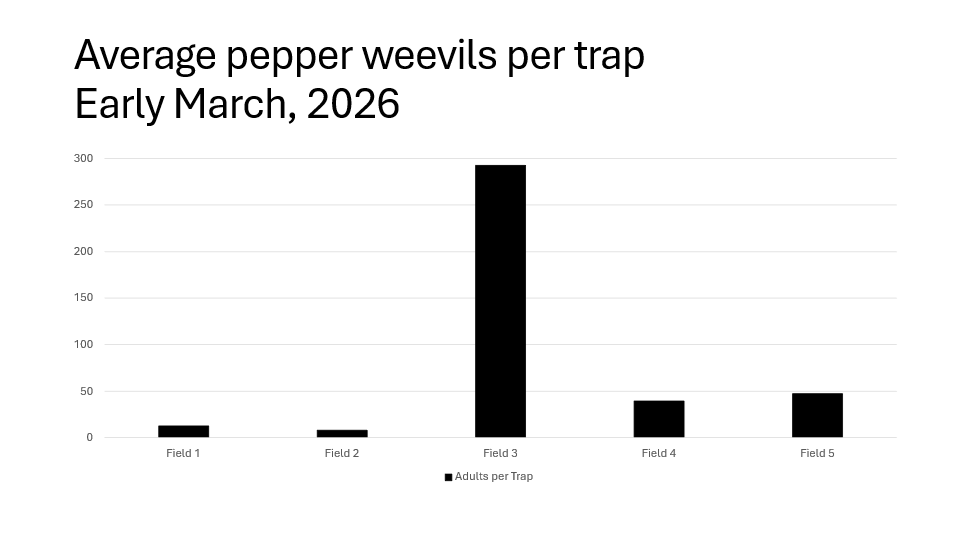
Something has apparently gone awry this year. While we did have a large peak in trap captures in January, and a drop in late January and February, we have experienced an increase in captures in early March (see Winter 2025-26 data below). Captures during early March in five fields (shown below) averaged roughly 80 adults per trap, with NO zeros (which is unusual for this time of year), three fields with 30 or more adults per trap (which is very high for this time of year), and one with an average approaching 300 per trap.
At this point there is no obvious explanation for these high trap captures. The most obvious explanation would be that there is an unknown food source available that was not previously available or was not previously utilized by the weevils or that pepper weevil has adapted and is now diapausing in our area. Both are unlikely and either would greatly complicate weevil management.
For now, growers should be aware of the potential for early infestations in their pepper fields and apply sprays to prevent establishment of reproducing populations in their fields. Pepper fields are very attractive to weevils and they will enter immediately after transplanting, but they cannot reproduce until fruiting structures are present. The general recommendation is to allow new transplants to attract weevils into the field and spray those fields at first sign of any fruiting structures within the field. For this particular pest, scheduled insecticide applications (on a maximum 5-day schedule) are generally recommended for prevention. This is a pest which is nearly impossible to control once established in a field.